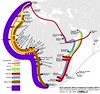
 It’s looks as though the West African Cable System (WACS) has passed from the realm of the press release into something more concrete. A consortium of telcos signed a construction and maintenance agreement yesterday (8 April 2009) in Johannesburg.
The signatories to the cable agreement are:
- Telkom
- Vodacom
- MTN
- Tata Communications (Neotel)
- Broadband Infraco
- Cable & Wireless
- Portugal Telecoms
- Telecom Namibia
- Togo Telecom
- Angola Telecom
- Sotelco (U.S.)
The will cable stretch from South Africa to London connecting Namibia, Angola, the Congo, The Democratic Republic of Congo (DRC), the Canary Islands, Cameroon, Nigeria, Togo, Ghana, Cote d’Ivoire, Cape Verde, and Portugal along the way.
One look at the African Undersea Cable Map and you can see that this initiative dwarfs all others. However, it will be interesting to see how the economics of this cable play out as it will only be lit in Q2 2011, two full years after Seacom has been in services and a year after EASSy has been lit as well as MainOne and/or GLO1 possibly. It looks as though 2011 may be as big a shake up in international bandwidth pricing in South Africa as 2009 promises to be.
It will be interesting to see whether this Telco-dominated consortium will have woken up by then to the reality that uptake and not ARPU is the road to cost recovery. As a back of the napkin analysis, here’s what you get when you divide the total cable cost by the distance covered and the total capacity, giving a cost per gigabyte per second per kilometre.
| WACS | 11 USD |
| EASSY | 19 USD |
| TEAMS | 22 USD |
| GLO1 | 24 USD |
| MainOne | 32 USD |
| Seacom | 37 USD |
That would appear to give WACS an edge in the long term, as long as they fill the cable! Of course the above figures are so rough as to possible make the calculation worthless. For instance, Seacom offers connectivity direct to London whereas TEAMs customers will have to negotiate onward connectivity from Fujairah to Europe. It is hard to compare eggs with eggs in undersea cables so take the above with the appropriate grain of salt.
The formalisation of WACS is unlikely to be good news for cables that still have yet to nail down all of their financing. For MainOne and GLO1 it will now be a race to get their cables in the water and lit to generate as much revenue as possible before WACS goes live. Also, it is interesting to speculate to what extent all this undersea access will affect the O3B satellite network. If I were the betting type, my money would not be on O3B today. Looking forward, however, to being proved wrong 🙂
The latest version of the African Undersea Cables Map can always be found at http://manypossibilities.net/african-undersea-cables/
Pingback: What does local content have to do with low-bandwidth applications? : crisscrossed blog
Steve, I only saw your great update just now.
Re the non-bet: O3B might still have an enormous edge over providing access to landlocked countries and regions that lack domestic high-speed cabling. Uganda, CAR, Malawi, northern MZ, etc. I think if we’re talking about connectivity beyond the capitals and various landing points, most countries other than SA will still need O3B desperately, if only to increase pressure and competition.
Of course, the picture changes if participating telcos are smart enough to provide wider access to these cables, but my gut tells me that mobile networks can be trusted more to provide that quickly and efficiently.
@tino Uganda have deployed a national fibre network (funded by the Chinese). Malawi and Mozambique have fibre underway. They may have more luck in CAR, DRC, etc.
But the bottom line is that O3B’s pricing is going to have to get a lot more aggressive than it is. From what I’ve heard they are quoting prices in West Africa that even SAT3 can beat. 🙂
@steve You’re right, I was mostly thinking of the more extreme places like CAR, Chad, or Niger, where even twice the SAT3 pricing would be welcomed by the small markets there.
Thanks for the posts re UG, MZ & MW — I wonder if mobile networks will be given favorable access to resell bandwidth over GPRS at much cheaper rates than at present in these countries.
Hi Steve.
You mentioned onward connectivity in relation to Seacom and TEAMS. Do you know what the rates are for onward connectivity to the Far East and Europe from Fujairah? With regard to the same what are the onward connection rates from London to say Mumbai, Beijing, HongKong, Singapore and Seoul? I ask this because the bandwidth rates for the Far East may be more important for Kenya or EAC than the traditional London route. What are your thoughts on this?
Hi François, I am not an expert on buying international undersea bandwidth but as I understand it, it all comes down to who you peer with. My impression is that it is not so important whether you terminate in London or Hong Kong but rather whether you have terminated somewhere where there is cheap high-speed peering. Thus there is pressure for any undersea cable service provider to offer a package that terminates somewhere near lots of other international fibre and where there is a competitive environment for peering so that you pay as little as possible. Having achieved that, I don’t think it matters so much where you are geographically unless you are carrying the sorts of bandwidth that moves terabytes every day such as GEANT/Internet2 etc.
This is why Seacom have negotiated transit to London even though their cable lands in Marseille because London is much more of an Internet hub than Marseille, although why London and not Amsterdam or another European hub, I have no idea.
Hi again François. I have taken the liberty of consulting someone with more expertise than me in this area. I asked Rudolph van der Berg, author of the excellent blog Internet Thought to clarify. He says:
Hi Steve.
Thanks for the great info. Having talked of onward connectivity dont you think it would make enormous sense if say SEACOM and EASSy was to link up with WACS, SAFE or MAINONE around South Africa? In the same regard there is already talk of TEAMS and SEACOM linking up through KIXP(Kenya Internet Exchange point) or via Mombasa. Infact if all the cables on the East African coast materialize then Kenya will indeed be a hub as will South Africa because many landlocked countries vizualize Rwanda, Uganda, Burundi, Ethiopia and South Sudan will want connection to the cables which all have landing stations in Kenya. Given the BPO activity and the development of local content we could begin to create a serious broadband traffic node with connection to the Middle East, India and Far East in addition to the traditional London. In addition the numerous terrestrial national fibre-optic networks being rolled out all over Africa will mean greater African inter-connectivity which then reinforces the ring around Africa concept. Your thoughts on this?
@Tino Speak of the devil. I see that O3B have just signed a deal in DRC.
My specific question is:
For a cables like EASSy or WACS, do we have ALL fibers arriving in EACH landing stations or just some?
The sub-question is:
In case we just have some specific fibers arriving in each landing stations, this therefore means that this is possible to have DIRECT connexion between landing stations without having to go trough other station.
Regards,
Mandi
Hi Mandi. EASSy lands at Mtunzini on the east coast and WACS lands at Yzerfontein on the west coast so no there is no shared fibre at the landing stations. The cables interconnect via terrestrial fibre infrastructure in South Africa.
Hello Steve,
My question is what’s happening between Mtunzini and Port-Soudan ? Do we have the whole fiber out of the water in each stations or just some pairs?
Tks,
Mandi
This could explain:
http://eassy.org/network_resilience.html